Entô
At Entô, dinner is not a pause from the island. It is another way of seeing the sea, the season, and the people who bring food to the table.
In This Article
- Why dinner at Entô keeps the sea present after the day moves indoors
- How local ingredients are connected to fishers, farmers, and the island itself
- Why Italian technique changes the way Oki ingredients are seen
- How drink pairings reflect the limits and possibilities of a remote island
- Why breakfast and a second dinner can change the shape of the stay
At Entô, dinner matters less as a restaurant reservation than as a way of keeping the island present after the day moves indoors.
You may have spent the afternoon looking across the water, walking through the island, or simply watching ferries move between the shores of the Dōzen Caldera.
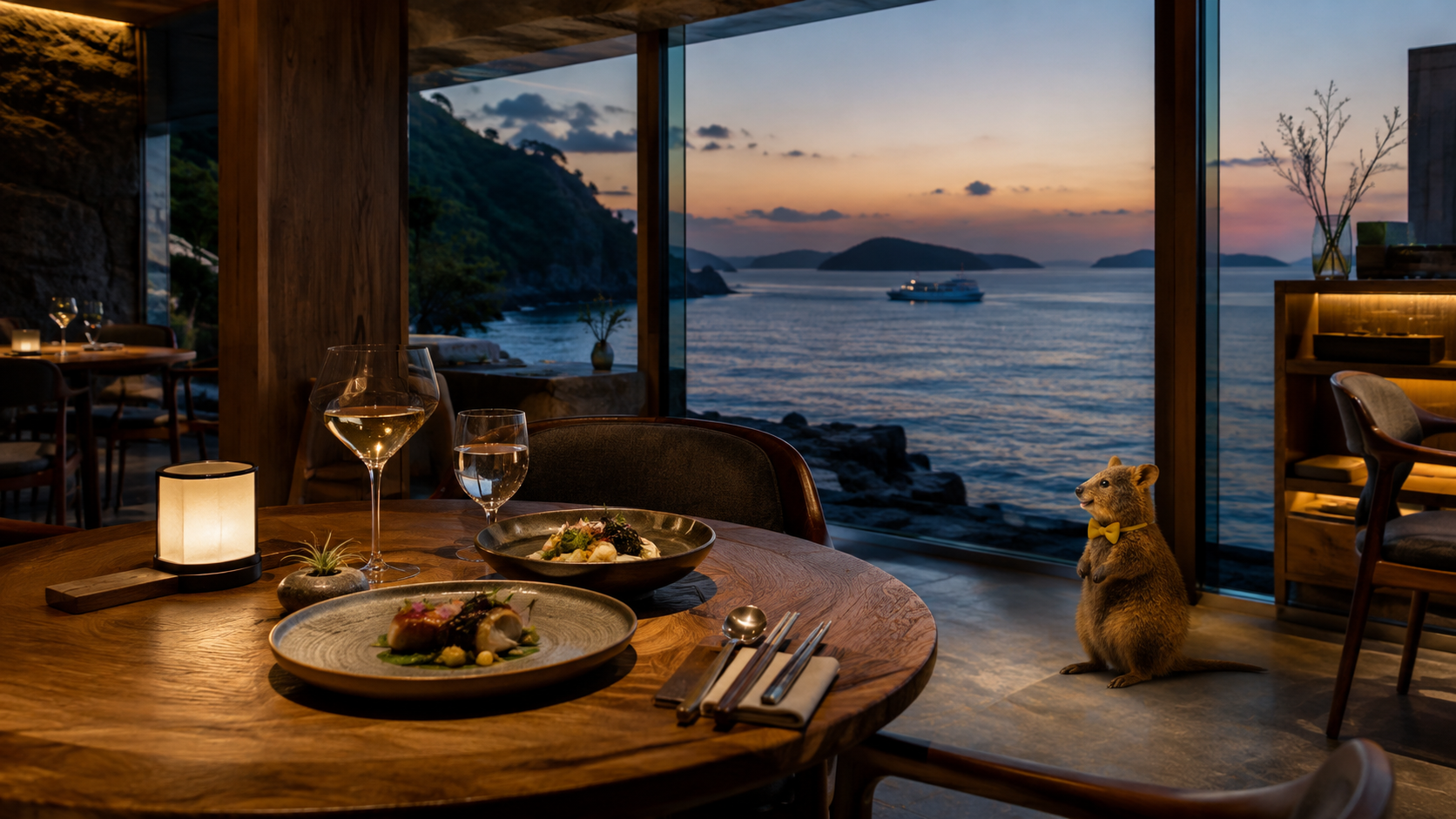
Dinner does not require that landscape to disappear. The sea remains beyond the glass, while ingredients arriving from Oki move onto the plate.
The value of eating here begins with that continuity: the journey does not stop when you sit down. It changes form.
Dinner does not ask you to leave the sea behind
Entô Dining faces the water, and that matters for more than the conventional pleasure of an ocean view.
Imagine leaving a sea-facing room in the late afternoon. You move through the hotel, take your seat, and the first plate arrives. Outside, the water is still there. A ferry may cross the view. Near sunset, the brightness of the sea and the islands beyond it begins to change.
You have moved from the room to the dining table, but the visual subject of the day remains the same.
That is particularly important at Entô because looking is already a meaningful part of the stay. The island does not need to provide another attraction every hour.
Dinner extends that slower rhythm rather than replacing it with a separate hotel experience.
The strongest reason to eat at Entô is not that the restaurant is inside the hotel. It is that the island remains part of the evening after you sit down.
The first course arrives while there is still light on the water. You look up between plates and find that the sea has changed colour. No additional excursion is required; the evening has already begun.
Look beyond “local ingredients” to where the food came from
Entô describes its kitchen as working with seafood, mountain vegetables, and traditional ingredients, much of it sourced directly from fishers, farmers, and foragers around the islands.
The distinction matters. “Local food” can easily become a label attached to a menu. Here, the more useful question is what the island is able to provide at this particular moment.
The catch changes. Plants appear and disappear with the season. Weather and distance influence what can reach a kitchen on a remote island.
Rather than treating those conditions as inconveniences, the meal can be read through them.
Dinner becomes less a catalogue of Oki specialties than a record of what has arrived from the island now.
The point is not simply that the food is produced nearby. The meal becomes another place where the conditions of the island remain visible.
Italian technique changes the angle, not the subject
Entô Dining builds its seasonal course around Italian culinary techniques. That description is most useful when read as a method, rather than as the destination of the meal.
The point is not to make Oki taste like somewhere else. It is to create enough distance from a conventional ryokan dinner that the ingredients can be noticed differently.
Fish does not need to function as an example of “Japanese cuisine.” A vegetable does not need to become an explanation of regional culture.
The plate can instead return attention to the ingredient, its season, and the place from which it arrived.
For an international traveller, this matters because the meal does not require prior knowledge of Japanese dining conventions. The island can be understood through what is served.
The technique is most convincing when it does not obscure Oki, but adjusts the distance from which the island is seen.
Each plate has to carry more than presentation. It sits between the producers who supplied the kitchen and the landscape still visible outside.
On a remote island, limitation can become part of the pairing
Entô also offers a drink pairing designed around what it calls “Oki’s time” — the island’s geology, seasonal changes, and the stories of the people living here.
That idea is particularly appropriate on a remote island, where the logic of a metropolitan wine cellar does not necessarily apply.
Distance affects supply. Availability itself becomes a condition. The value therefore does not come from pretending that every possible bottle is within reach.
It comes from allowing the person serving the meal to decide what makes sense here.
For travellers who want a rigidly predetermined wine programme, that may not be the attraction. For those willing to let the island’s circumstances enter the glass, it can make the pairing more personal.
Stay two nights and dinner no longer has to represent the whole island
Entô currently serves a different course on the second evening for guests staying multiple nights.
The practical detail changes the rhythm of the stay.
On a single night, dinner can easily become the meal that is expected to explain the destination all at once. With a second evening, that pressure disappears.
The first dinner follows the journey to Oki. By the second, you already know the harbour, the building, the distance to the water, and how quickly the light changes outside.
The first dinner can introduce the island. The second is a return to an island you have begun to recognise.
A second dinner removes the need to treat one course as the definitive Oki experience. The dining room remains the same, but your relationship with the island has already changed.
Breakfast places you on the island again before you start moving
Entô’s breakfast is built around rice from Ama Town, side dishes, and warm soup.
It is a quieter proposition than dinner, and that difference is useful.
Wake up. Look at the water. Move to breakfast. Eat something warm. Only then begin the next part of the day.
On an island reached by ferry, it is easy to turn the morning immediately into logistics: departure times, luggage, transfers, the next destination.
Breakfast delays that switch. For another hour, the body remains where the journey has brought it.
The sea that disappeared into darkness the night before is visible again. Your luggage is still in the room. Eat rice from Ama Town and something warm before turning the morning into a ferry schedule.
The landscape is not background decoration for the meal. It is the place from which the evening has been assembled.
Make dinner part of the stay if you want the island to remain present after dark
Entô Dining is not most compelling as a destination restaurant detached from everything around it.
Its strength comes from connection: the sea you have been looking at, ingredients reaching the kitchen from Oki, the judgement of the people preparing and serving them, and the same landscape waiting outside the glass.
Travellers who prefer to leave dinner completely open until the end of the day may find the structure restrictive. The course has set service times, requires advance planning, and is reserved separately from the room.
But for a traveller willing to let dinner become part of the island rather than a break from it, that structure has a purpose.
Who should make Entô Dining part of the stay?
Dinner is reserved separately from accommodation. Entô currently lists regular dinner starts at 18:30 or 19:30, with a course of roughly seven to eight dishes served over approximately two hours. Same-day reservations are not accepted, so dining should be considered when planning the stay rather than after arrival.
At Entô, dinner gives the day somewhere to continue: the sea moves from the window to the edge of the table, the island enters through what has been gathered and cooked, and breakfast places you there once more before you leave. The reason to dine here is not to step away from Oki, but to stop moving without losing sight of it.
Check the stay around the dinner, not the other way around
If Entô Dining is part of the reason for travelling to Oki, allow the meal to shape the evening rather than fitting it between other plans.
Check Availability