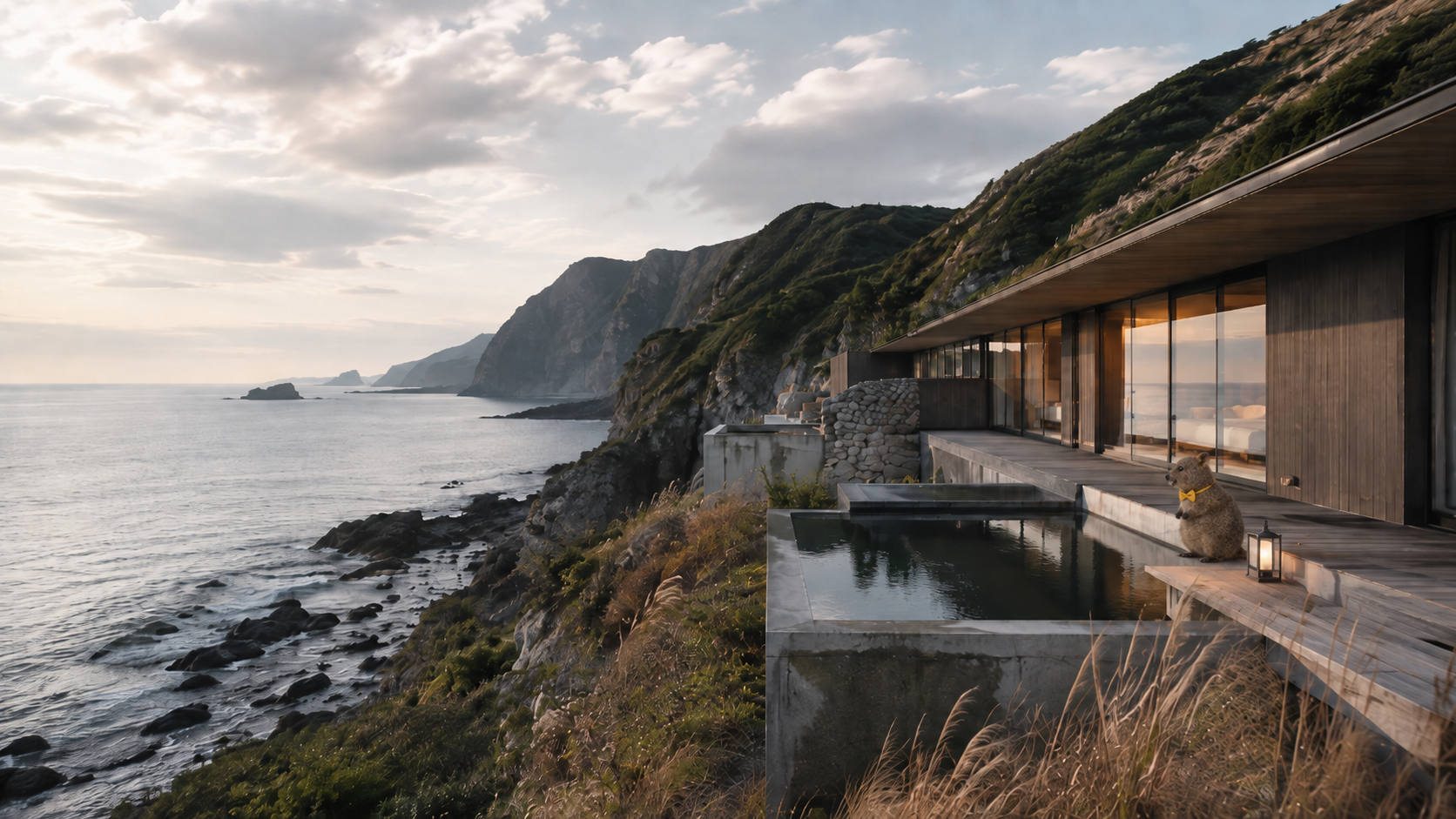
Entô #01 A Stay That Gives Distance a Purpose
On Nakanoshima Island in the Oki Islands, a hotel that turns remoteness into meaning.
is part of
the stay.
You cannot reach Entô from Tokyo by air alone.
From the Japanese mainland, the journey continues across the sea to the Oki Islands, around 60 kilometers north of the Shimane Peninsula. Entô stands in Ama Town on Nakanoshima Island. Once the ferry arrives, the hotel is only a short walk from the port. Reaching that port, however, takes time.
Entô does not try to disguise that inconvenience.
That is precisely why it belongs in Faraway.
The distance is not something to overcome before the stay begins. It is part of the process of arriving in Oki.
The Stay Begins Before You Reach the Port
In journeys built around efficiency, transit time is something to reduce.
A trip to Entô works differently.
The mainland recedes, the ferry moves out across open water, and eventually the outlines of the islands begin to appear. Oki consists of four inhabited islands and many smaller uninhabited ones, shaped by geological processes that extend back millions of years. Around the Dōzen area, Nakanoshima, Nishinoshima, and Chiburijima sit within the remains of an ancient volcanic caldera.
The sea and islands visible from Entô are therefore not scenery arranged for a hotel.
They are the reason for having travelled this far.
Even Inside the Room, the Island Remains Present
Entô has two accommodation wings: BASE, adapted from the property’s earlier building, and NEST, completed in 2021. Across the property, guest rooms face the sea.
In NEST, the rooms are designed with a broad frontage and relatively shallow depth, keeping the water visually close from much of the interior. The more important point is not any individual piece of furniture or amenity, but the way the plan repeatedly directs attention outward.
After arriving and setting down your luggage, there may be little reason to explore the building immediately.
Sit near the window instead.
Boats move between the islands outside. After spending hours travelling across the same water, watching that movement begins to change the meaning of the journey. Transit becomes part of the stay rather than time lost before it.
“The more you understand inside, the more reasons you have to leave the building.”
Inside the Hotel Is an Entrance to the Island
What separates Entô from a conventional island resort is the way accommodation and geopark functions occupy the same place.
Geo Room “Discover” introduces the geological formation of Oki and the characteristics of the Dōzen islands. Elsewhere in the building, displays draw attention to the far longer timescale behind the landscape outside.
The point is not simply to look at exhibits.
Learn something about the islands in the morning, then walk outside. A cliff, a shoreline, or a stretch of exposed rock that might previously have registered only as scenery begins to carry different information.
Rather than enclosing the destination within the hotel, Entô does the opposite.
The more you understand inside, the more reasons you have to leave the building.
Dinner Does Not Separate You from the Island
That connection continues when you return in the evening.
Entô Dining works with seafood, meat, vegetables, fruit, and other ingredients sourced from producers around the islands, alongside seaweed and herbs gathered locally. Breakfast similarly draws on ingredients from Ama Town, including local rice.
The significance goes beyond the familiar idea of “local sourcing.”
The sea you looked across, the fields you passed, and the scale of life on the island return at dinner in another form.
Sightseeing, accommodation, and food do not operate as separate parts of the itinerary here. They reinforce one another.
That is also one reason a second day begins to matter.
By Morning, the Same View Means Something Different
The next morning, the sea outside the window has not changed.
Your understanding of it may have.
After learning how Oki was formed, travelling between islands, and eating ingredients produced by people who live here, the landscape no longer functions only as a backdrop.
Entô is less a hotel for consuming a view than a place from which to understand what you are looking at.
This is why an overnight arrival followed by an early departure can feel incomplete.
The room is a place from which to look at the islands, but it is also a starting point for going back outside.
Who Entô Is — and Is Not — For
Yes, if…
Entô suits travelers willing to treat the destination itself as the main event: people who do not consider a ferry crossing wasted time, who can remove one item from the following day’s schedule in order to walk the island, and who are prepared to return to their room and look at the same landscape again.
For those travelers, the hotel’s restraint is not an absence.
It leaves more room for attention to move back toward Oki.
Maybe not, if…
Entô is not the most obvious choice for travelers who expect an island resort to provide a self-contained sequence of amenities.
If your idea of luxury depends on moving between a pool, spa, lounge, multiple restaurants, and other facilities without leaving the property, there are hotels better designed around that expectation.
The name “Entô” carries an association with entō, a Japanese term linked to distant islands and historically to exile in remote places. Oki itself has long been shaped by that history of separation from the mainland.
But the important thing about Entô today is not remoteness alone.
You cross the sea to reach it.
A volcanic caldera lies beyond the window.
Inside the hotel, you learn how that landscape was formed.
Then you step outside and encounter it directly.
Later, ingredients from the islands return to the table.
When those elements connect, distance gains a purpose.
Entô is not a hotel that gives you a reason to visit Oki. It is a hotel designed to help you see why Oki itself was worth the journey.