Entô
The boat, the number of nights, the dinner reservation, and the empty hours all shape the stay before you reach the hotel.
In This Article
- Why the boat should be decided before the hotel arrival time
- How to choose between ferry time and island time
- Why one night and two nights create very different stays
- What should actually be reserved before arriving
- How to leave enough empty time for Oki to change the plan
Entô becomes easier to understand when the journey is treated as part of the stay rather than as a problem to finish before it begins.
First, you travel to a port on the mainland.
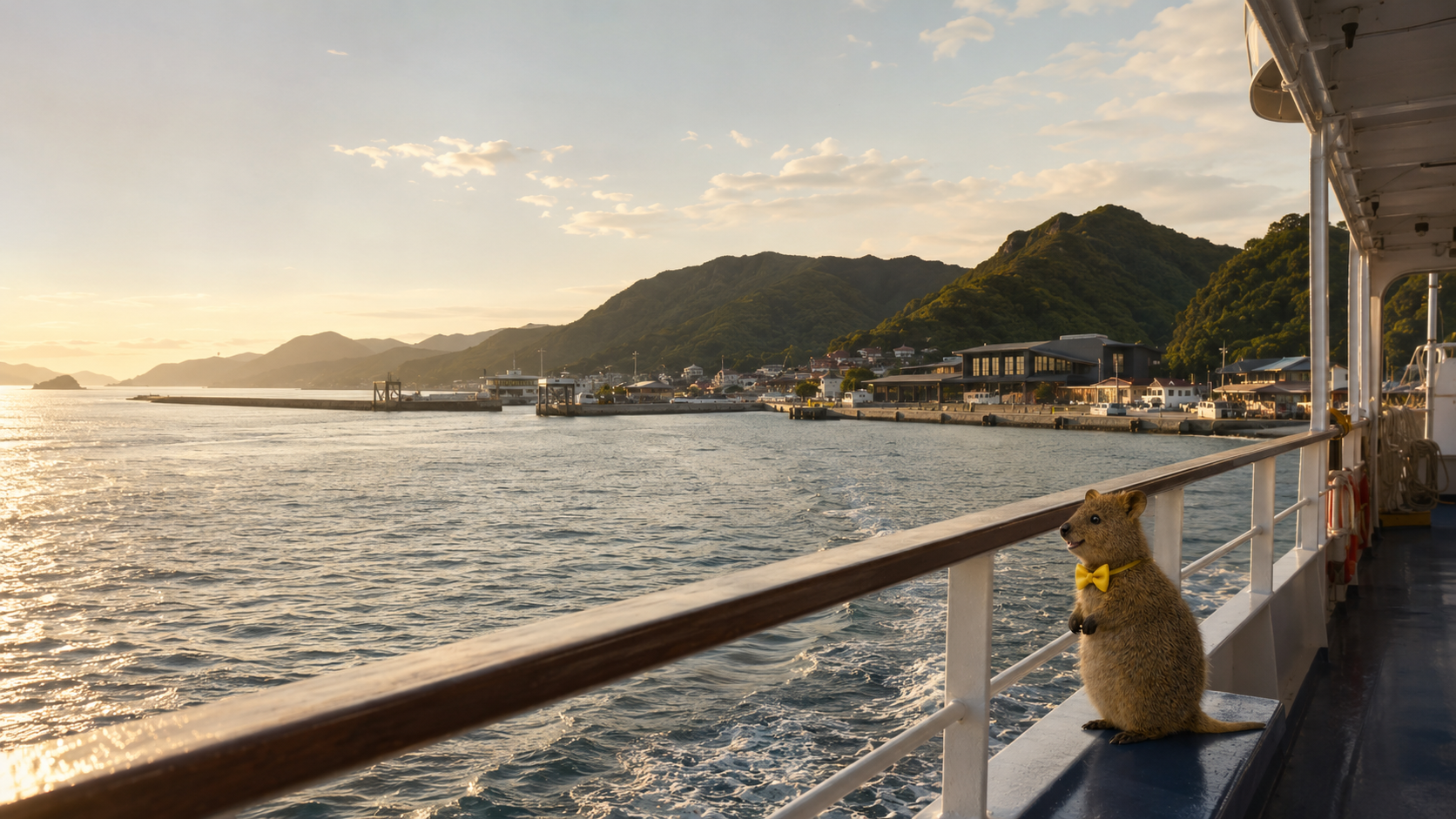
Then you board a boat. You cross the sea. You enter the Oki Islands and eventually reach Hishiura Port in Ama Town.
From there, Entô is only a short walk away.
The final transfer is easy. Everything before it gives the destination its sense of distance.
Which boat you take, how many nights you stay, when dinner is reserved, and what you leave unplanned all begin shaping Entô before check-in.
Choose the boat before you choose the arrival time
When travelling to Entô, the first useful decision is not what time you want to check in.
It is how you will cross to Oki.
Hishiura Port is the gateway to Ama Town. From the mainland, the islands are served by ferries and the fast ferry Rainbow Jet, with schedules changing according to season.
Flying is also possible, but Oki Airport is on Dōgo Island, not Nakanoshima where Entô stands.
Arrival by air therefore still requires another movement across the islands.
Decide which vessel you will use, where you will connect, and when you reach Hishiura. The hotel arrival time largely follows from there.
The boat is not merely the final transfer. It is the point at which ordinary overland movement gives way to the geography of the islands.
The boat begins to determine the shape of the day. That small loss of flexibility creates the first real boundary between the mainland and the island.
Do not choose between the ferry and fast ferry only by speed
If the only measure is travel time, the fast ferry is the obvious choice.
But on a Faraway journey, the shortest option is not automatically the better one.
A larger ferry gives the crossing more physical presence.
The mainland becomes smaller. Open water takes over. Eventually the islands begin to grow again.
Rainbow Jet makes more sense when the priority is protecting as many hours on Oki as possible.
Being able to stay one night does not mean one night is always the best stay
Entô works as a one-night stay.
But one night and two nights create very different journeys.
With one night, most of the stay is concentrated between the afternoon of arrival and the following morning.
You see the room. Watch the sea. Have dinner. Wake up. Have breakfast.
That can be enough to understand why Entô works.
With two nights, one full day becomes available.
You can go outside, return to Entô, and wake the following morning without immediately turning the day into a departure.
Two nights do more than double the stay. They separate the day of arrival from a day that genuinely belongs to the island.
A second night gives the island enough room to become more than the landscape around an arrival and departure.
Do not leave dinner until after you arrive
If you intend to eat at Entô Dining, consider dinner at the same stage as the room reservation.
Dinner is booked separately from accommodation, and availability is limited.
The same principle applies if you plan to eat elsewhere on the island: choices are more limited than in a city, so advance planning can matter.
The goal is not to reserve every hour.
Reserve the things that genuinely need to be fixed so that fewer decisions remain after you arrive.
Plan the boat. Plan dinner. Then resist the temptation to plan everything in between.
Do not plan island transport as though you were in a city
Inter-island boats make movement between the Dōzen islands possible, while rental cars, E-bikes, and taxis provide options on land.
But availability is finite.
The useful approach is to reserve what you genuinely need without reserving the entire day.
Book transport when necessary. Leave space around it.
If the wind is strong, change the plan.
If the weather is good, ride farther than expected.
If nothing feels necessary, return to Entô.
On an island, a changed plan is not automatically a failed plan.
Delete one destination from tomorrow’s plan. Let an hour open. Stop at the harbour, get off the bicycle somewhere unexpected, or return to Entô early. The empty hour may remain longer than the third place you intended to see.
Travelling this far does not create an obligation to fill every hour once you arrive. Empty time is part of what makes the distance useful.
Plan the final day around the boat home
Entô’s check-out time is 10:00.
But the final day is shaped less by check-out than by the vessel that will take you away.
An early departure changes breakfast. A later boat leaves time after check-out.
You do not need to treat leaving the room as the end of the trip.
Leave the luggage. Walk again. Have lunch. Return to the harbour.
Then board the boat and look back across the water toward the island where you have just stayed.
Arrival happened gradually across the sea. Departure can work the same way.
What kind of itinerary works best for Entô?
Six articles later, the final question is still about distance
#01 asked why it was worth coming this far.
#02 looked at how room choice changes the distance to the sea.
#03 followed the island into the dining room.
#04 went outside after learning how to read the landscape.
#05 looked at the architecture that adjusts all of those distances.
The final question is practical: how should the journey itself be built around them?
Entô is not complete when you press the booking button.
Choose the boat. Leave some time empty. Remove a few plans. Cross the sea. Spend time on the island. Then cross the sea again.
Faraway does not mean choosing a hotel simply because it is difficult to reach. It means choosing a place where distance changes the way you travel.
Book the stay, then build the journey around the sea
Before confirming the itinerary, check current ferry schedules, decide how much island time you want, and reserve only the parts of the stay that genuinely need to be fixed.
Check Availability