Entô
Entô’s architecture becomes most interesting when the building itself recedes and the sea, island, and movement of people come forward.
In This Article
- Why NEST uses width to keep the sea close
- What “Honest” means in a timber building on a remote island
- Why “Seamless” is about transitions rather than removing boundaries
- How NEST and BASE create different distances from people and landscape
- Why the architecture works best when you stop looking directly at it
Entô becomes more interesting when you stop asking what the building looks like and begin asking what the building keeps directing your attention toward.
The architecture does not announce itself through one spectacular lobby or one dominant gesture.
Instead, the distance between room and sea, solitude and shared space, interior and island changes gradually as you move.
Entô calls the idea “Honest & Seamless.” Those words make more sense as descriptions of how the stay is organised than as a visual style.
In NEST, width matters more than depth
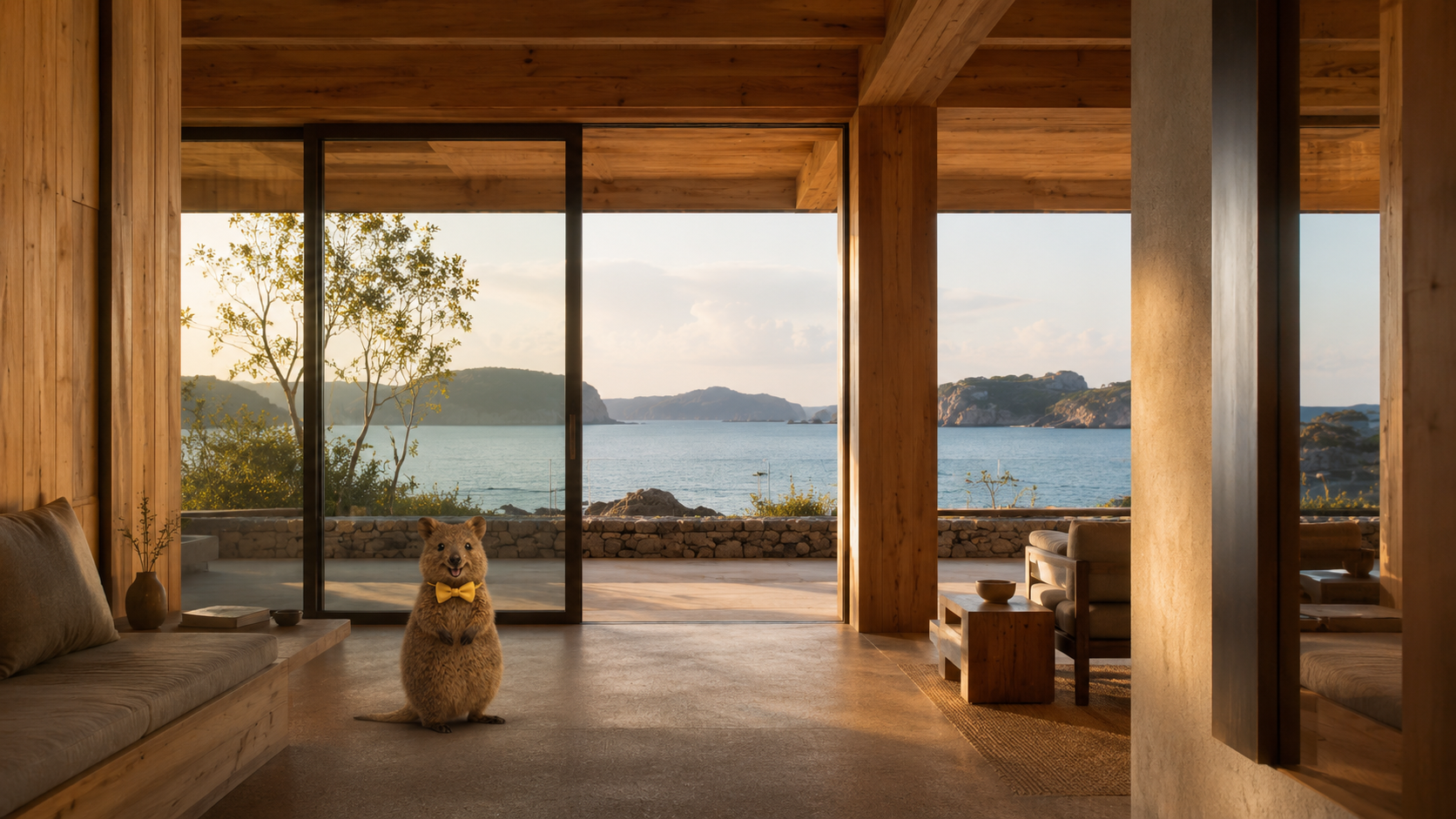
NEST rooms are characterised by broad frontages and relatively shallow floorplans.
That proportion does more than make a room feel visually generous.
Instead of moving deep into the interior, you remain almost parallel to the water.
From the bed, from a chair, or while crossing the room, the sea remains difficult to lose.
The architecture does not decorate the sea. It steps back from in front of it.
The value of the room is not only its floor area. It is how consistently the architecture keeps the landscape within reach.
You wake up and the sea is already there. Before standing, you can tell whether the water is bright or grey, whether the wind has risen, and whether a boat is already moving.
The important question is not that it is made of wood, but why wood is used this way
NEST is a timber structure using CLT — Cross Laminated Timber.
On a remote island, construction is shaped by transport, weather, labour, and the practical limits of distance.
That makes the material more interesting when it is read as a response to conditions, rather than simply as a visual sign of nature.
Structure is not excessively hidden. Materials are not asked to perform unnecessary decoration.
“Honest” works because the building does not completely disguise the conditions required to make it possible.
“Seamless” does not mean inside and outside become the same place
Seamless is better understood as a reduction in the force of transitions.
You look at the sea from the room. Walk through a corridor. Move into the Geo Lounge. Step outside. Continue toward BASE.
Each movement changes the situation, but the architecture rarely announces a completely new world.
Sightlines continue. Light continues. The sea returns repeatedly.
The relationship with the island changes angle without being completely interrupted.
Entô feels continuous not because every space is the same, but because the island keeps returning between them.
The building works most clearly when knowledge, structure, and the present landscape occupy the same field of view.
NEST and BASE are not simply new and old
It is tempting to understand the two buildings as a comparison between new architecture and an older hotel.
Their difference is more useful when read through the role each plays in a stay.
NEST often turns attention outward, toward the sea and landscape.
BASE brings back reception, dining, bathing, shared spaces, and the presence of other people.
In NEST, the distance between yourself and the landscape contracts.
In BASE, the life of the hotel returns.
Leave a NEST room after looking at the sea. Walk back toward BASE. Someone is heading to dinner. Someone is speaking at reception. For a moment, other stays become visible again.
Architecture at Entô repeatedly adjusts the distance between solitude and connection.
In the Geo Lounge, architecture begins working before the exhibition does
Geological objects and traces of ancient life direct attention toward deep time.
Beyond them is present-day Oki.
You can look at evidence of the past and then raise your eyes to the sea outside.
A room for looking backward in time and a place for looking at the present have not been separated.
Knowledge and landscape, past and present, hotel and geopark occupy the same visual sequence.
If you look at the award, look at why the architecture was recognised
Entô’s architecture received a Good Design Award in 2025.
The more useful point is not the award itself, but the relationship it recognises between landscape, structure, and the way people occupy the building.
Entô is not architecture that can be understood from one definitive photograph.
Enter the room. Look at the sea. Walk toward BASE. Sit in the Geo Lounge. Step outside.
The building becomes clearer when you notice how often it allows itself to disappear behind the experience.
This architecture is most rewarding when you notice relationships rather than spectacle
Entô may initially feel restrained to travellers who prioritise a spectacular lobby, obviously expensive finishes, or one dramatic architectural moment.
Its architecture becomes more interesting when you begin asking different questions.
Why is the room shaped this way? Why is the sea visible from here? Why do NEST and BASE ask you to occupy the hotel differently?
Entô distributes its architectural value through small movements rather than concentrating it in one showpiece.
Who will notice this building most?
To look at architecture at Entô is not to make the building itself the main subject. It is to notice how much closer the sea becomes, how easily solitude shifts back toward other people, and how little the building needs to announce itself while doing both.
Stay long enough to notice what the building is doing in the background
Entô’s architecture is easier to understand through a sequence of rooms, views, shared spaces, and returns to the sea than through a single architectural photograph.
Check Availability