Wabi-sabi Retreats #05
How Dinner, Breakfast, and Timing Decide the Stay
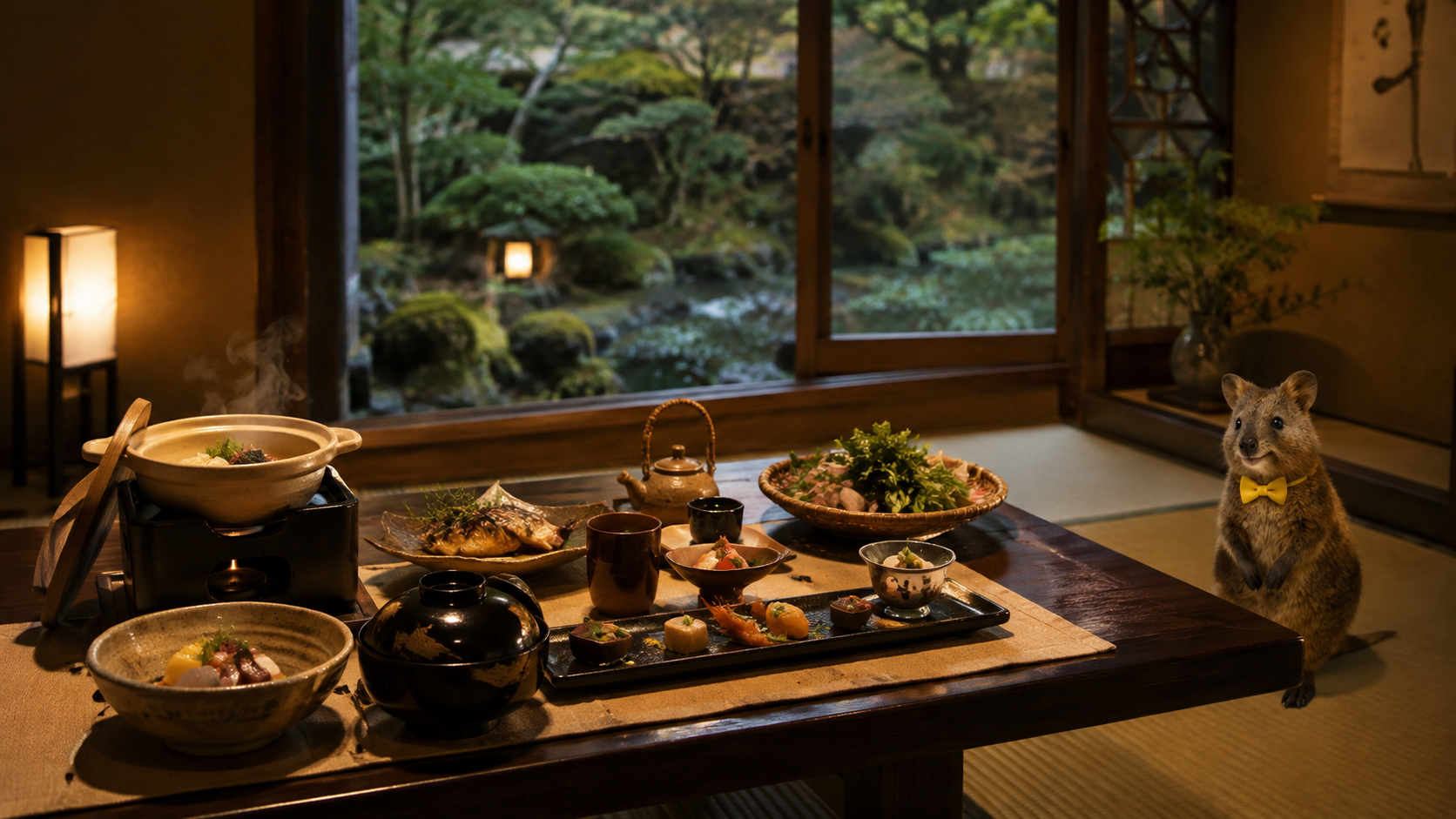
AI-generated editorial image. This image is an editorial interpretation and may not depict the property exactly.
In This Article
- How Asaba's in-room dinner and breakfast shape the practical rhythm of the stay.
- What the official dining information confirms about ingredients, timing, and requests.
- How access, check-in, bath hours, and room choice affect booking decisions.
- Who Asaba suits best after reading the full series.
Dining & Practical Guide
The final decision is practical as much as atmospheric
By the final article in this series, Asaba has already been considered through its rooms, Gekkeiden, architecture, culture, and baths.
Dining brings those pieces into a practical order because both dinner and breakfast are served in the guest room.
The official dining page places Asaba's ingredients in a regional map: the foothills of Mount Fuji, Suruga Bay, the Kano River, the Amagi mountains, and Izu.
For the traveler, the meal is not only taste. It determines arrival time, the evening's movement, the morning's pace, and whether the ryokan can become the center of the itinerary.
This guide treats food and logistics together because they decide whether Asaba works as intended.
Dinner in the Room
Dinner keeps the evening inside the ryokan
Asaba's official dining information states that the accommodation price includes in-room dinner and breakfast, with dinner served between 18:00 and 19:00.
This is the practical hinge of the stay. Arrive too late, and the evening loses the slow transition from room to meal to bath.
Because dinner comes to the room, the guest does not have to turn the night toward a restaurant, taxi, or town walk. The table becomes the point where Izu enters the private space.
That structure is why dining belongs in the final guide. It affects not only appetite, but the whole order of arrival.
Izu at the Table
Regional ingredients give the meal its geography
The official page describes ingredients gathered from the foothills of Mount Fuji, Suruga Bay, the Kano River, the Amagi mountains, and the lands of Izu.
That range matters because Asaba does not need dinner to become a separate excursion. The surrounding region arrives through fish, mountain ingredients, seasonal dishes, and the room's service rhythm.
The example course menu includes sashimi of local fish and squid, grilled red bream, fried Asaba-style lobster, rice, miso soup, pickles, and seasonal dessert options.
Additional menu options, such as black abalone, natural sea bream, Ise lobster, Matsuba crab, rosy sea bass, matsutake dishes, and Wagyu shabu-shabu, are described as seasonal or requiring advance reservation.
From the Official Instagram
Breakfast and Morning
Breakfast should not be treated as an exit procedure
Asaba's official dining page describes breakfast in the comfort of the room, with Japanese or Western-style course options.
The Japanese breakfast includes home-dried grilled fish and a fluffy egg dish. Official information lists breakfast timing between 8:00 and 9:00, while check-out is 11:30.
Those times give the morning room to breathe. A guest can wake, bathe during the 06:00 to 10:00 public bath period, return for breakfast, and still leave without collapsing the morning into packing.
The best Asaba departure is therefore planned backward from breakfast, bath, taxi, and train rather than treated as a standard hotel checkout.
From the Official Instagram
Requests and Occasions
Special requests belong before arrival
The official English dining page says vegetarian or religious requests can be accommodated if given three days notice.
It also notes special-occasion arrangements such as flowers, cake, champagne, and Tai sea bream broiled in a salt crust.
These are useful details for international travelers because they move uncertainty out of the night itself.
A ryokan dinner can feel highly personal, but it is easier to enjoy when dietary needs, celebration requests, and additional dishes have already been handled before check-in.
Access and Final Fit
The right Asaba itinerary protects the slow hours
Asaba is located at 3450-1 Shuzenji, Izu-shi, Shizuoka. By train, the official access page lists the limited express Odoriko from Tokyo Station to Shuzenji Station at about 120 minutes, followed by about seven minutes by cab.
Another route uses the Shinkansen to Mishima, then the Izu Hakone Railway to Shuzenji Station. Asaba can also arrange a private cab from Mishima Station to the ryokan.
The important practical point is that Asaba does not provide a complimentary station shuttle, so the final transfer should be planned.
This ryokan suits travelers who can arrive in time for the evening sequence: room, dinner, bath, salon or quiet return, sleep, breakfast, and a measured departure.
Final Planning Guide
Who should choose Asaba?
Use these practical filters after reading the full Asaba series.
Travelers who can arrive before dinner and stay inside afterward
Asaba works best when dinner, bath, room, and morning are protected from a crowded itinerary.
Travelers with dietary, bath, or transfer concerns
Confirm requests, tattoo policy, private bath procedure, room details, and transfer arrangements before arrival.
Travelers using the ryokan only as a place to sleep
A late arrival and early departure can still be comfortable, but it weakens the value of in-room dining, bathing, Gekkeiden, and morning.
The best booking decision is the one that gives Asaba enough time to work.
The guide ends where the stay begins
Asaba is not difficult to understand, but it is easy to misbook if the schedule is treated like a standard hotel night.
The room needs time. Dinner needs arrival before evening. The bath needs a gap after the meal or before breakfast. Gekkeiden needs repeated sight rather than a rushed glance.
Food brings Izu into the room, while access, timing, bath questions, and dietary requests determine whether the guest can receive that experience without friction.
That is the practical conclusion of the series.
Choose Asaba when the itinerary can make room for the ryokan itself to become the main event.
Wabi-sabi Retreats
Return to the Wabi-sabi Collection
Explore more stays shaped by quiet architecture, natural materials, hot springs, gardens, and slower ways of moving through Japan.
Back to Wabi-sabi