Wabi-sabi Retreats #03
Gekkeiden Is Not a Museum Piece
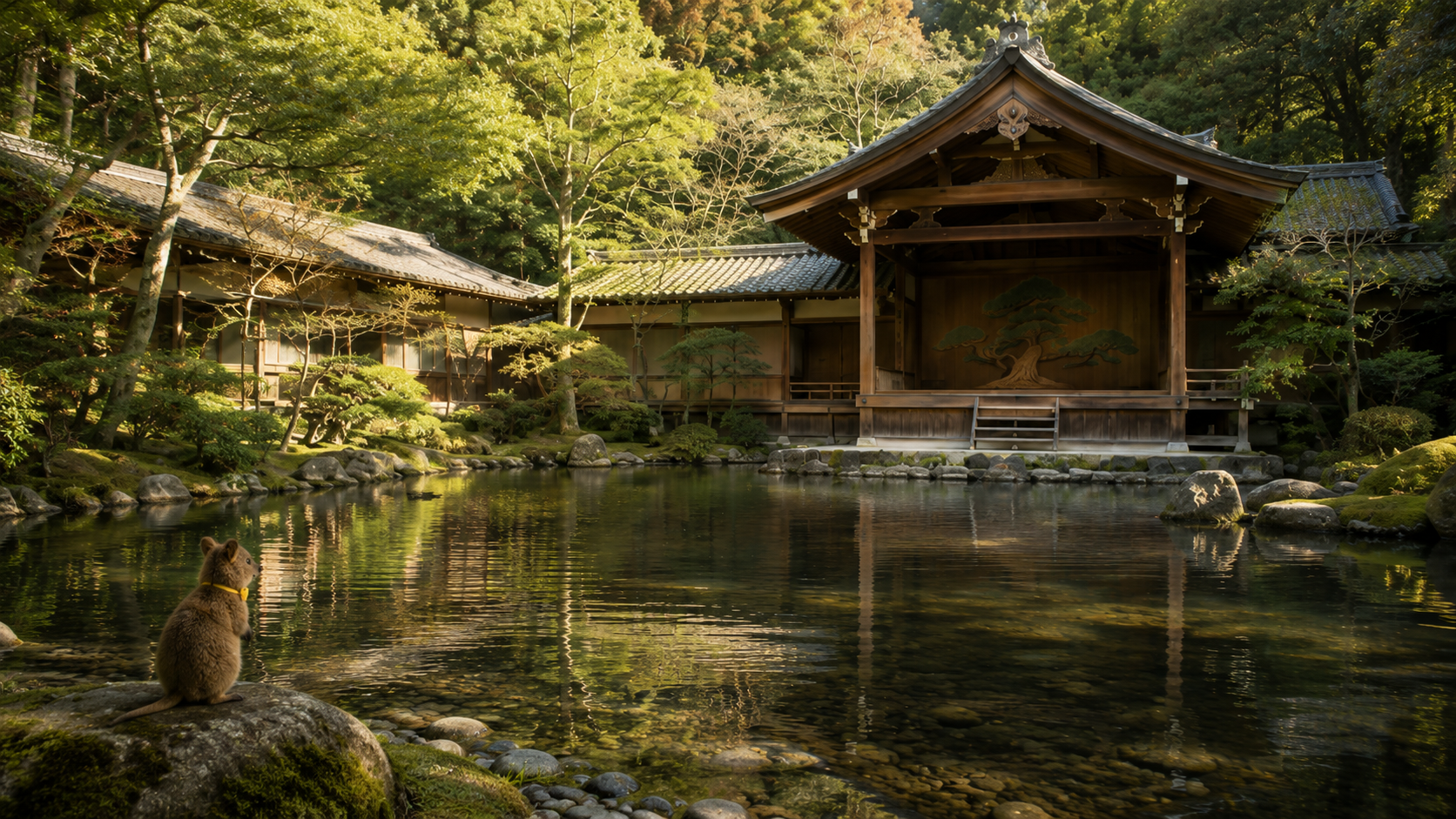
AI-generated editorial image. This image is an editorial interpretation and may not depict the property exactly.
In This Article
- Why Gekkeiden functions as the cultural anchor of Asaba.
- How the pond and garden keep the architecture present during ordinary hours.
- What Asaba Cultural Journey reveals about the stage as a living space.
- Why the value is not only heritage, but the way heritage remains usable.
Architecture & Culture
The stage participates in the stay before a performance begins
Gekkeiden is the image many guests remember from Asaba: a Noh stage standing across the pond, held by water, garden, and the surrounding ryokan buildings.
The official history gives the stage a clear origin. It was donated by Viscount Toshika Maeda, relocated from Fukagawa Tomioka Hachimangu Shrine in the late Meiji period by the seventh-generation proprietor Yasuemon Asaba, and has become central to Asaba Cultural Journey.
Those facts matter, but this article is concerned with a different question: how does a cultural structure remain part of a present-day night at a ryokan?
At Asaba, the answer is spatial. The stage is not encountered once. It appears across the pond, beside the rooms, after dinner, in the morning, and sometimes as the setting for traditional performing arts.
Gekkeiden gives the stay a cultural center before it gives the guest an event.
Across the Water
The pond makes culture part of the daily view
The stage matters because it is placed where ordinary guest time can meet it.
Across the pond, Gekkeiden does not require the visitor to enter a theater. It sits within the visual field of the ryokan, so architecture and water become part of the same rhythm.
A guest may see it while moving between room and bath, from a pond-facing room, or while returning to the same area after dinner. The repeated sight is quieter than an explanation panel, but it changes how the property is understood.
The pond performs a practical editorial role. It creates distance, reflection, and pause, allowing the stage to remain present without becoming an object that must be consumed immediately.
Living Performance
Asaba Cultural Journey keeps the stage in use
Asaba's official Cultural Journey page describes performances of traditional Japanese arts, including Noh, kyogen, Shinnai storytelling, Japanese dance, and other seasonal programs.
The importance of this is not only that famous traditions are named. It is that Gekkeiden is not treated as a decorative survival from another era.
When performances take place there, the stage returns to its original condition: a place where bodies, voice, instruments, timing, and audience attention gather.
For an international traveler, this distinction is useful. A historic ryokan can easily become a sequence of preserved surfaces. At Asaba, the cultural surface has a function that may still be activated.
From the Official Instagram
Architecture Without Display
Preservation feels strongest when it avoids exhibition
The architecture at Asaba does not need to announce itself as heritage in every moment.
Wood, tatami, screens, corridors, low rooms, garden edges, and pond reflections work because they are tied to use. Guests sit, eat, bathe, look out, return, and sleep within the same set of materials.
That is why the property does not feel like a museum even when its history is long. The buildings support gestures that continue into the present.
The design value is therefore not only visual. It is behavioral: the architecture makes certain actions feel natural, especially returning to the same places rather than searching for new ones.
Guest Distance
The guest remains close enough to feel culture, far enough to let it breathe
Gekkeiden's placement across water creates a useful distance. The stage is visible, but it is not crowded by the guest.
That distance gives the architecture composure. It lets the garden, pond, and buildings frame the stage without turning every glance into a touristic close-up.
For a stay, this matters. The guest can live near the cultural center without needing to constantly interpret it.
A room, a bath, a meal, and a morning view can all remain ordinary, while Gekkeiden holds the larger cultural register of the property.
Cultural Fit
Who will feel the value of Gekkeiden most clearly?
This article is for travelers deciding whether Asaba's cultural atmosphere is central to the stay or simply a background feature.
Travelers who can give time to repeated views
Gekkeiden becomes more meaningful when the guest sees it across several hours rather than treating it as a single photograph.
Travelers interested in traditional performing arts
If a Cultural Journey performance aligns with the travel dates, the stage can move from visual anchor to live cultural setting.
Travelers using Asaba mainly as a base for sightseeing
Guests who leave early, return late, and spend little unassigned time inside the ryokan may experience Gekkeiden only as scenery.
The official event calendar should guide any performance-centered plan.
Culture here is not separated from the night
Gekkeiden gives Asaba a cultural center that can be seen before it is explained.
Its history is specific: donated by Viscount Toshika Maeda, moved from Fukagawa Tomioka Hachimangu Shrine in the late Meiji period, and used in Asaba Cultural Journey for traditional performing arts.
Yet the strongest experience for many guests may happen outside a formal performance. The pond holds the stage at a distance. The garden softens the frame. The room, bath, dinner, and morning keep returning the guest to the same architectural presence.
That is why Gekkeiden belongs in the middle of the series rather than only in the introduction.
At Asaba, culture is not something added to the stay. It is one of the structures through which the stay keeps time.
Read Next
Asaba #04
Continue to the onsen and the quiet hours between dinner, sleep, and morning.
Read #04Wabi-sabi Retreats
Return to the Wabi-sabi Collection
Explore more stays shaped by quiet architecture, natural materials, hot springs, gardens, and slower ways of moving through Japan.
Back to Wabi-sabi