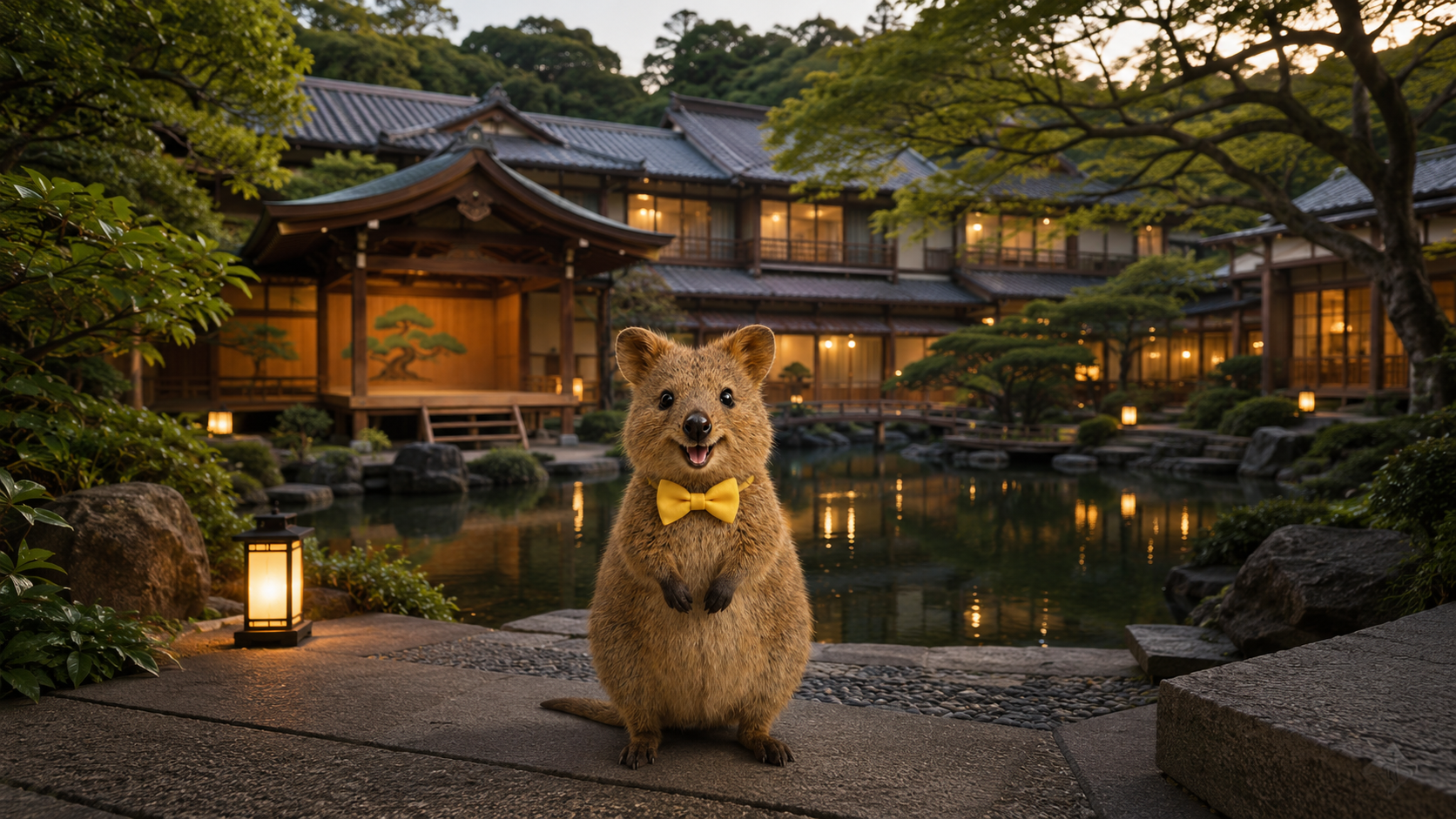
Wabi-sabi Retreats #01
Spending a Night Inside What Has Been Preserved
At a Glance
The reason to choose Asaba is not simply to say that you have stayed at a ryokan whose history reaches back to 1484.
It is the sequence that follows: the pond in the late afternoon, dinner beginning in the room, the hot spring, an evening with no need to find somewhere else to go, and the same pond and Noh stage seen again the following morning.
Here, history remains present because it continues to participate in the hours of a stay.
Introduction
What matters is not only that Asaba is old, but that its spaces are still being used
A day in Shuzenji can include its temple, bamboo paths, and the streets of the hot-spring town. Once you enter Asaba, however, treating the ryokan as one more sight on that itinerary makes less sense.
Asaba traces its origins to 1484 and has been passed through the Asaba family for more than five centuries. Within the property, Gekkeiden—a Noh stage transferred from Tokyo in the late Meiji period—stands over the pond.
For a guest, however, the dates themselves are not the most important part.
Gekkeiden is not separated from the present as a preserved relic. Traditional performing arts, including Noh and kyogen, continue to be staged there. The rooms, garden, pond, baths, and meals are likewise not objects to inspect; they form part of the way a night unfolds.
At Asaba, age and present-day use have not been separated.
That relationship determines the pace of the stay.
Arrival
A ryokan that asks you to return to the same view
After arriving, there is little need to keep looking for the next thing to see.
The pond and Gekkeiden remain points of reference as you move through the property, look outside from the rooms, and experience the changing hours.
There is the remaining light on the water in late afternoon. After sunset, the outline of the stage and its surroundings changes. The next morning, you encounter the same place again.
Sightseeing usually encourages movement: see something, then continue to the next place. A ryokan can work in the opposite direction.
By returning to the same view at different hours, small changes begin to matter.
The architecture and Gekkeiden deserve their own examination in #03 of this series. For now, what matters is not the age of the structure but this repetition.
See Gekkeiden once in the late afternoon and again the following morning.
What has increased is not the number of sights, but the amount of time spent with the same one.
Evening
When dinner requires no journey, the evening remains in the room
At Asaba, dinner and breakfast are served in the guest room.
That arrangement reduces the geography of the night.
There is no restaurant to walk to for dinner, and no corridor to retrace after the meal. The focus of the journey, directed outward toward Shuzenji during the day, begins to contract into the room as evening arrives.
Ingredients come from the surrounding region, including Suruga Bay, the Kano River, the Amagi area, and the foothills of Mount Fuji.
The food itself will be explored in #05.
For the introduction, the more important point is that contact with Izu does not end when you return to the ryokan. There is no need to leave again to find it; part of the region arrives at the room as dinner.
After Dinner
Leaving the hours after dinner unassigned
When dinner ends, the night does not require another destination.
You can go to the salon. You can enter the hot spring. You can remain in the room.
Asaba's open-air bath surrounded by bamboo, indoor bath made with koyamaki wood, and private bath will be examined more closely in #04.
For now, the number of bathing facilities matters less than the sequence they allow.
Dinner ends in the room. You walk through the ryokan. You bathe. You return.
None of these actions is a major event. Together, however, they prevent the hours after dinner from being lost to another journey outside the property.
After dinner, there is no need to open a map.
The next decision may simply be whether to bathe now or remain in the room a little longer.
Morning
The stay is completed by seeing the same place again
Breakfast also begins in the room.
After eating, there is no need to close the luggage immediately and resume the itinerary.
Look at the pond in the morning. Bathe once more. Return to the room.
Gekkeiden is still there—the same stage you saw the previous afternoon.
This second encounter matters at Asaba.
Instead of adding another place to the trip, you return to somewhere you already know, now under different light and with the body at a different point in the day.
Only then does the time that began the previous afternoon feel complete.
Stay Judgment
The kind of journey Asaba suits—and the kind it does not
Best for
- Travellers who can finish sightseeing in Shuzenji and give the remainder of the afternoon through the following morning to the ryokan.
- Guests who enjoy returning to the same pond, garden, bath, and room at different hours rather than continually seeking new stimulation.
- Travellers who would rather receive dinner in the room and reduce movement during the evening than leave the property in search of another destination.
Not ideal for
- Travellers trying to cover as much of Izu as possible before returning to the ryokan late.
- Guests who want dinner to lead into a night of visiting outside restaurants and bars.
- Travellers who approach a historic ryokan expecting the volume of exhibits and explanations found in a museum.
Practical Notes
- Asaba is located in Shuzenji, Izu, Shizuoka Prefecture.
- Travellers arriving by rail continue from Shuzenji Station by taxi. The ryokan does not provide a complimentary station shuttle, so international travellers using public transport should include that final transfer in their plans.
- Room size, outlook, bedding configuration, and the availability of an in-room hot-spring bath vary by room. Choosing solely by size or price misses part of the decision; the relationship to the pond or garden, and how much time you intend to spend in the room, also matter.
- Those differences will be examined in #02.
Final Take
Why choose Asaba
More than five centuries of history would mean little to a guest if they remained only a number.
At Asaba, that duration becomes visible through present-day actions.
You look across the pond toward Gekkeiden. Dinner from Izu arrives in the room. Afterward, you remain inside the ryokan, choosing between the bath, the salon, and the room. You sleep. The following morning, you look at the same pond again.
The point is not to see something old once and move on.
Returning to the same place at a different hour becomes the journey itself.
That is the reason to choose Asaba not merely as somewhere to stay in Shuzenji, but as the part of the itinerary where time is deliberately allowed to remain in one place.
Wabi-sabi Retreats
Return to the Wabi-sabi Collection
Explore more stays shaped by quiet architecture, natural materials, hot springs, gardens, and slower ways of moving through Japan.
Back to Wabi-sabi