Wabi-sabi Retreats #03
How the Forest Garden, Architecture, and Libraries Hold the Stay Still
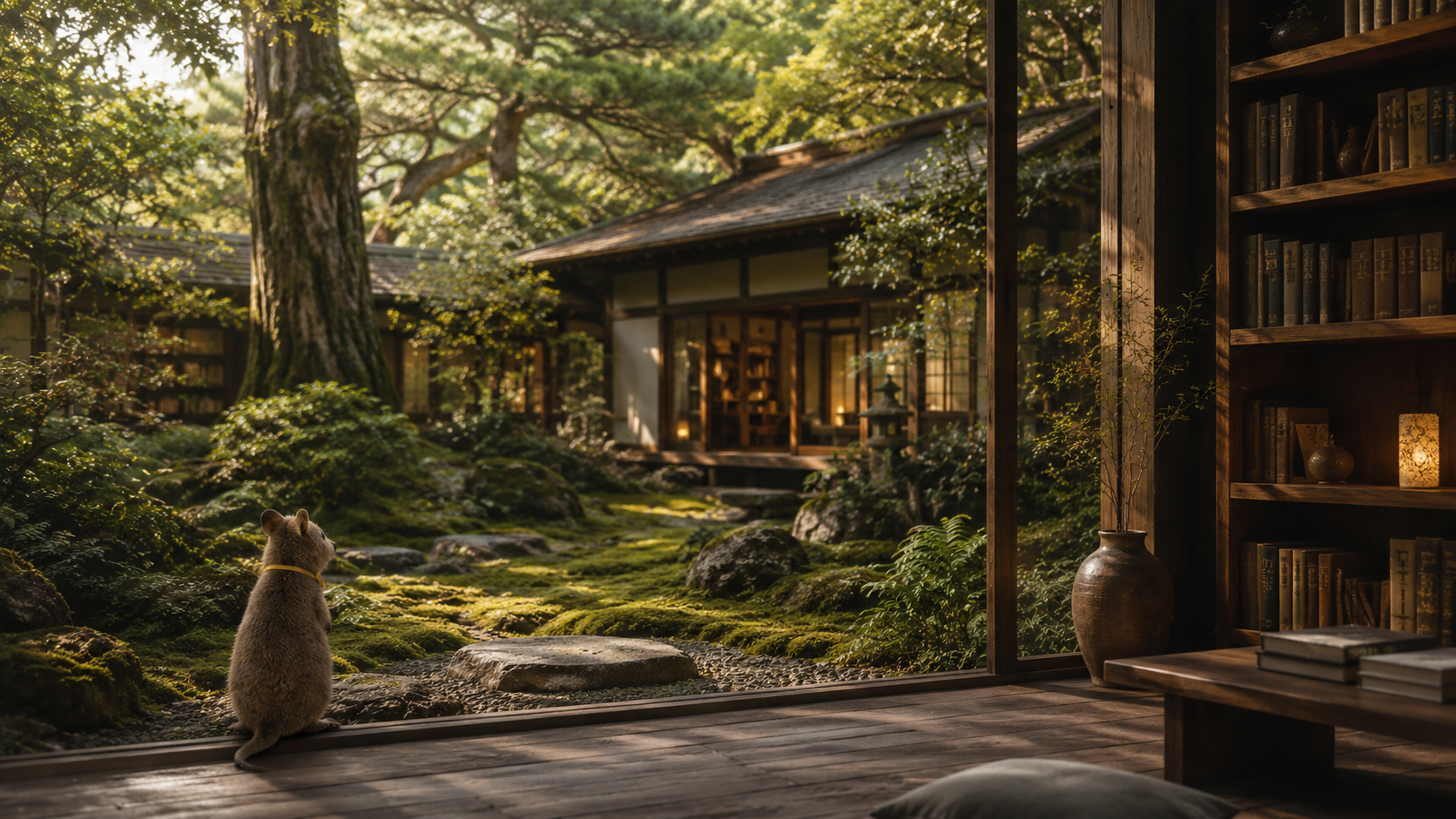
AI-generated editorial image. This image is an editorial interpretation and may not depict the property exactly.
In This Article
- How the Forest Garden acts as the spatial center of the ryokan.
- Why architecture and natural materials matter through movement and pause.
- How the libraries give unstructured time somewhere to settle.
- Why these shared spaces should not be read as a facilities checklist.
Forest Garden and Architecture
Beniya Mukayu’s shared spaces are quiet because they give time somewhere to go
After the room, the next part of Beniya Mukayu to understand is the space between rooms: the Forest Garden, the entrance sequence, the terraces, the material surfaces, and the libraries.
These are not attractions in the usual sense. They do not ask the guest to complete them. Their value lies in how they make walking, sitting, reading, and looking feel sufficient for a while.
The series anchor deepens here. Empty time becomes credible only when the property gives that time a physical setting.
The garden and architecture make stillness spatial rather than merely atmospheric.
Forest Garden
The Forest Garden is the ryokan’s center of gravity
At many hotels, a garden is something guests visit. At Beniya Mukayu, the Forest Garden works more quietly because the rooms face it and the shared spaces continue to refer back to it.
This changes the garden’s role. It does not need to be consumed in a single walk. It remains beside the stay as the guest moves from room to bath, from reading to dining, from morning to departure.
The 300-year-old Akamatsu red pine noted in the series planning is useful not as a symbol to overexplain, but as a reminder that the property’s strongest image is vertical, rooted, and slow. The garden makes duration visible without turning it into a museum label.
From the Official Instagram
Entrance and Materials
Architecture slows the guest through surfaces and thresholds
Beniya Mukayu’s architecture should be read through ordinary transitions: the approach from outside, the change in floor texture, the movement toward the lobby, the way wood, paper, bamboo, tatami, and earth-toned surfaces lower the volume of the space.
Natural materials are often used as a vague luxury signal. Here they matter because they reduce glare and keep the eye close to hand, wall, mat, and garden. The effect is physical before it is philosophical.
For a reader deciding whether this ryokan fits, that distinction is practical. If you want architecture that announces itself dramatically, Beniya Mukayu may feel restrained. If you want architecture that makes unhurried behavior easier, the restraint becomes the point.
From the Official Instagram
Libraries
The libraries give the unplanned hour a destination
The libraries at Beniya Mukayu are easy to underestimate because they do not sound as decisive as a private bath or spa. Their value appears after arrival, when the guest has time that does not need to become sightseeing.
A library gives that time a form. It is a reason to leave the room without leaving the property, a place to sit without ordering anything, and a way to let the ryokan remain active without adding noise.
For international luxury travellers, this is a subtle but important amenity. It supports a style of stay in which privacy does not mean isolation, and shared space does not mean social display.
From the Official Instagram
Spatial Judgment
These spaces matter if you plan to remain inside the ryokan
The Forest Garden, architecture, and libraries have the greatest value when the itinerary leaves room for them. If Beniya Mukayu is used only as a base for a fast regional trip, the subtler spatial strengths may pass too quickly.
They become more important when the guest returns from the room bath, waits before dinner, or wakes early with no immediate plan. The property then has enough small places to receive attention without forcing a program onto the day.
That is why this article belongs between Rooms and Onsen. It shows how the ryokan holds the hours that are not spent bathing, eating, or sleeping.
Stay Fit
When do the garden and libraries become a reason to choose the ryokan?
These spaces are most valuable when the guest allows unscheduled time to remain inside the property.
Choose Beniya Mukayu if shared quiet spaces matter to you
The Forest Garden and libraries support travellers who want somewhere to sit, read, walk slowly, and return to the room without needing an activity.
Choose it if material restraint is more appealing than spectacle
The architecture is most persuasive when read through texture, threshold, and relation to the garden rather than dramatic visual statements.
Look elsewhere if facilities need to feel abundant
Travellers seeking many lounges, bars, shops, and entertainment spaces may find the property’s quieter program too reduced.
The garden and libraries are not extras; they are the places where the day can remain unfilled without feeling empty.
The property gives quiet hours a physical address
Beniya Mukayu’s Forest Garden, architecture, and libraries matter because they hold the intervals that often disappear during travel.
Between bath and dinner, between dinner and sleep, between waking and departure, the guest needs places that do not demand performance. A garden outside the room, a surface that softens light, a shelf of books, and a path through the property can be enough when they are arranged with restraint.
This is where the ryokan’s idea of empty time becomes architectural: not a mood, but a set of places that make staying still possible.
Read Next
Beniya Mukayu #04
Continue to Yamashiro Onsen, public bathing, and Spa Entei as the healing context deepens.
Read #04Wabi-sabi Retreats
Return to the Wabi-sabi Collection
Explore more stays shaped by quiet architecture, natural materials, hot springs, gardens, and slower ways of moving through Japan.
Back to Wabi-sabi